Who Decides If An AI Weapon Is Ethical? Startup Helsing’s Approach
Reading Time: 6 Minutes
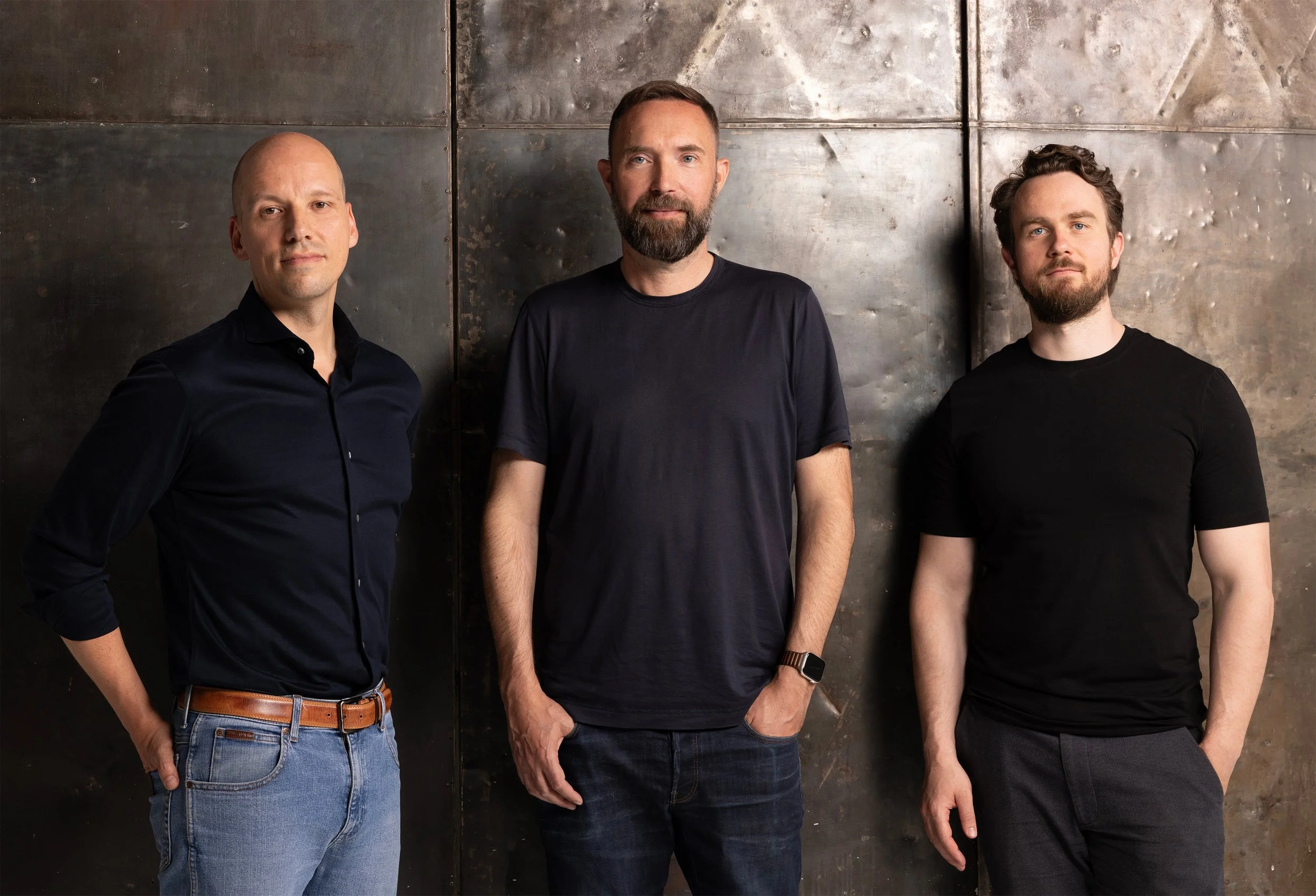
Helsing's three co-founders, Torsten Reil, Gundbert Scherf, and Niklas Köhler.
Source: Helsing AI
Helsing has raised $1.8 billion to scale technologies capable of acting in lethal environments. But who is responsible for the ethics here?
What can I expect from a subscription?
Real-world strategies for navigating the future of work.
AI AGENTS AT WORK
Everything you need to know about how AI agents are changing teams and ways of working.
SUPERHUMXN IRL
Real insights from investors and operators.
MEMOS ON PEOPLE, CULTURE & AI AT WORK
The latest use cases and strategies for change and transformation.
Round
Earmarked for growth
On July 13, 2026, Helsing announced a $1.8 billion funding round at an $18 billion valuation, both records for European defence-tech financing, surpassing Quantum Systems' $1.2 billion raise at an $8 billion valuation, set just eleven days earlier. A mix of new and existing investors took part, including Dragoneer, Lightspeed Venture Partners, and JPMorgan Chase, though Helsing hasn't specified which of the ten named participants are new to the company versus already on its cap table. Three other firms often associated with Helsing, Prima Materia, Accel, and Greenoaks, are existing shareholders but aren't confirmed to have taken part in this round.
That capital is earmarked for rapid growth, including more people building and deploying systems that make lethal decisions. Helsing’s ethical policies were designed for a smaller company. How will they hold up as it scales?

Image created by the Superhumxn team.
Neo Prime
Distribution of power
Helsing was co-founded by Torsten Reil, Gundbert Scherf, and Niklas Köhler. Reil explained that the regulatory, political, and technical complexity of building AI for defence was more than one person could hold, so the three split it between them from the start. The company no longer calls itself a startup and now uses the term "neo prime," a software-driven defence company competing directly with established contractors like Lockheed Martin, RTX, and Airbus. It employs more than 1,000 people, up from roughly 700 at the start of 2026.
Scaling lethal autonomous technology also scales the number of people making consequential decisions about how it's used. Helsing appears to address that challenge by involving experts and employees in ethical discussion through interviews, workshops, and an expectation of critical thinking. The company states that "all company staff" can "co-create, contribute to and critically challenge" its ethical decision process, and that the process itself is "transparent and standardised, providing accountability both at the time and historically." What isn't specified is whether that challenge carries the power to actually stop a critical decision being made.
Public
Military allegations
Bloomberg reported in 2025 that a Ukrainian military officer criticized the price of Helsing's HF-1 drone, roughly €16,700, calling it too expensive for what he described as a drone built largely from plywood, compared to similar drones costing around €2,200. Other sources cited in the same report pointed to glitchy targeting software and steep software markups as the reason for the price gap. A separate Bloomberg report in January 2026 said Ukraine had paused further orders of Helsing's HX-2 drone after takeoff failures during trials and reports that some autonomous-control components were missing from the units tested.
Helsing disputed both sets of allegations, saying its systems had performed well across more than 100 missions and that it wasn't aware of the presentation Bloomberg's second report was based on.
Axis
Three models
Helsing isn't the only organisation making decisions about lethal AI systems.
Anduril, the American defence-tech company founded by Palmer Luckey, builds autonomous weapons systems in the same broad category, and has raised at a far higher valuation than Helsing. Where Helsing describes an internal, company-wide process for ethical challenge, Anduril's public case for its work has come almost entirely through Luckey himself, in interviews and public statements.
The UK Ministry of Defence sits outside any single company altogether. It maintains an AI ethics advisory function made up of external and internal experts, reviewing how defence AI programmes are developed and deployed across the department, not inside one contractor.
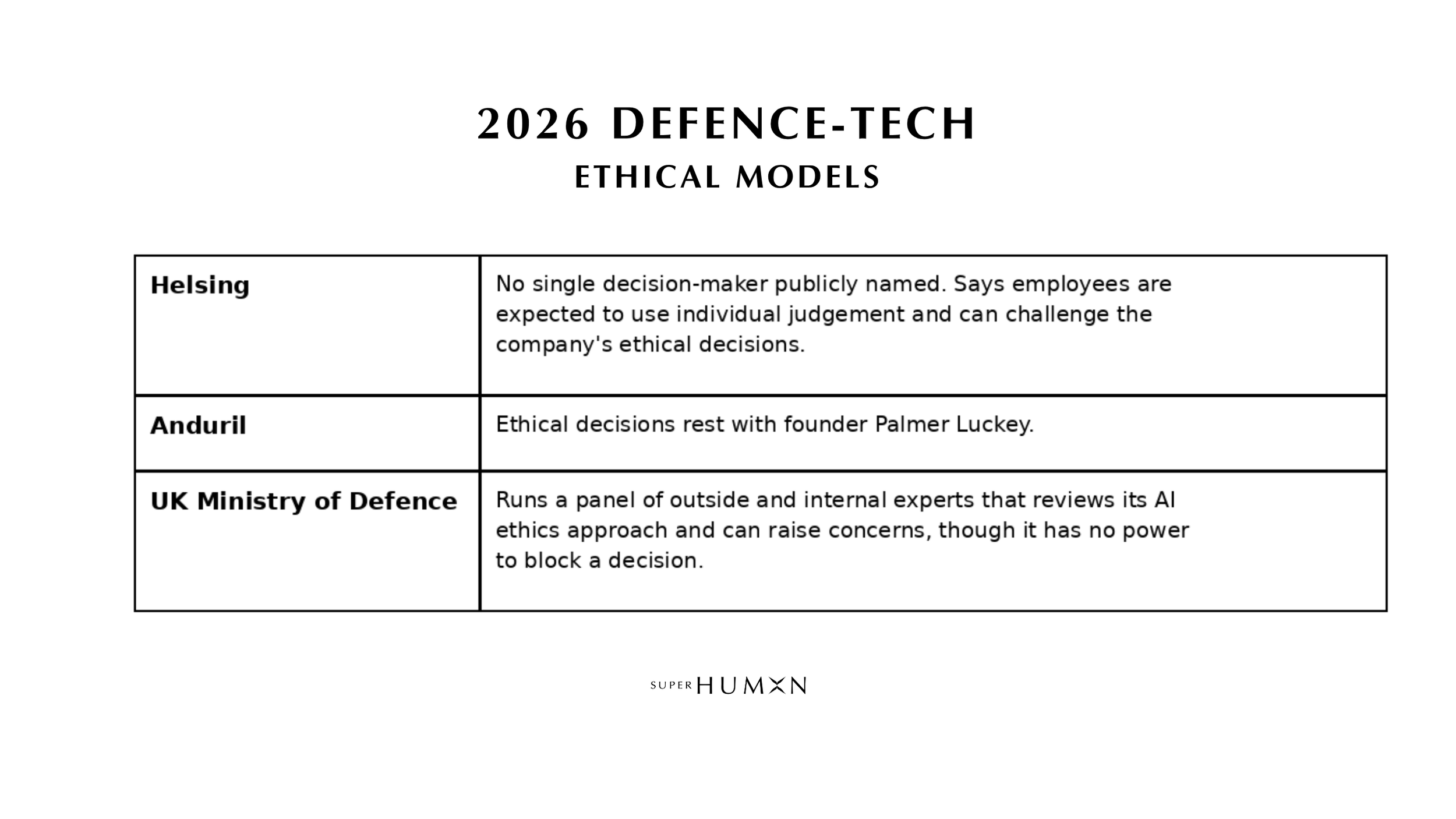
Image created by the Superhumxn team.
Luckey made the case for AI weapons: "There's no moral high ground in using inferior technology." But this doesn't establish where ethical judgment really sits inside the company. To further complicate things, OpenAI removed its blanket prohibition on military uses from its usage policies in January 2024 and announced a partnership with Anduril that December. The partnership, initially framed around counter-drone defence, prompted questions about how OpenAI could control the downstream use of its models once integrated into another company's defence systems.
The UK's Ethics Advisory Panel is chaired by the Ministry of Defence's Second Permanent Secretary and reviews the department's overall ethics approach rather than individual AI use cases. It can challenge, but it has no veto.
Each model presents a different failure point.
Close
The safety to say no
Helsing says employees can challenge how the company builds and sells its weapons. But the reality of this claim has not yet been tested.
A good example of internal ethical objection can be traced back to Google in 2018. More than 3,000 employees signed a letter opposing the company's Project Maven contract with the Pentagon, an AI system for analysing drone surveillance footage. Approximately a dozen employees resigned when the company didn't immediately respond. Following the revolt, Google decided not to renew the contract when it expired.
Later, in May 2026, Fortune reported that Google agreed to let its Gemini models be used inside classified US defence systems. Close to 600 employees initially signed a letter opposing the deal, a number Fortune reported later reached roughly 1,000. This time, Google didn't reverse course. Current and former employees told Fortune that the leverage available to employees in 2018 has eroded, in part because Google is no longer the only major AI company willing to work with the Pentagon.
Whether these outcomes came down to genuine ethical reconsideration or simply to how much leverage employees had at the time isn't known.
As AI takes on more consequential decisions, the need for clear ethical accountability grows. Helsing sits at the centre of that challenge.