Bezos Is Spending $12 Billion To Teach AI This
Reading Time: 8 Minutes

Image created by Superhumxn team.
Three vertical AI founders turned years of work experience into $42 million of funding. But what happens when AI takes the jobs that experience comes from?
Vertical
Ventilation to AI pipeline
Evan Brown spent his childhood summers working in his uncle's ventilation supply office. He went on to spend five years at Johnson Barrow reading construction plans, counting every duct and unit a building would need, and pricing the job so the company could bid for it. In March, his company Rebar raised $14 million in a Series A led by Prudence to automate the work those years had taught him.
Rebar was one of three companies raising this spring on a similar basis. Amigo AI, founded by Ali Khokhar, trains clinical agents to talk to patients. Fazeshift, founded by Caitlin Leksana and Timmy Galvin, collects unpaid invoices. Each company works because it knows one trade in detail. Investors call this vertical AI, software built around a single profession or workflow rather than a general capability, and some investors are doubling down on this emerging sector. For example, Prudence describes itself as an early-stage investor in vertical AI companies transforming the built world.
But the biggest bet in AI this year is on the centralised automation of multiple trades. Prometheus, the physical AI company co-led by Jeff Bezos and Vik Bajaj, launched in November with $6.2 billion and roughly 150 people, and in June raised $12 billion more at a $41 billion valuation from Bezos, JPMorgan Chase, Goldman Sachs and BlackRock. It is building what it calls an artificial general engineer, software intended to automate the design and manufacture of physical systems from jet engines to drug compounds.
Prometheus intends to buy its way to that ‘vertical’ level of expertise, factory by factory.
What can I expect from a subscription?
Real-world strategies for navigating the future of work.
AI AGENTS AT WORK
Everything you need to know about how AI agents are changing teams and ways of working.
SUPERHUMXN IRL
Real insights from investors and operators.
MEMOS ON PEOPLE, CULTURE & AI AT WORK
The latest use cases and strategies for change and transformation.
IRL
Compounding knowledge infrastructure
Rebar is essentially making its founder’s early career obsolete. Tasks like counting ducts and pricing bids, can now be done 60 to 70 percent faster by the platform. A contractor using the software needs fewer people learning the trade IRL. Fazeshift is doing the same to the clerks.
These products automate the repetitive years that used to teach people the trade. This change is widespread, with countless organisations removing roles from their own org charts as they redesign work around agents. Stanford's Digital Economy Lab found employment for early-career workers in the most AI-exposed occupations down 13 percent since late 2022, while employment for older workers kept rising.
Stanford’s researchers stop short of blaming AI outright, and economists are still arguing over how much of the decline is automation and how much is a wider hiring slowdown. Regardless, the reality is that inter-generational knowledge transfer is under threat. People become experts through years of trial-and-error. Someone still has to know when the software's answer is wrong after all.
So what happens when the next generation fails to acquire the practical expertise being handed off to AI? Analyst Shanaka Anslem Perera calls this the apprenticeship severance. While companies are cutting junior jobs, they might also be ‘cutting’ their future talent pipeline.
From the field
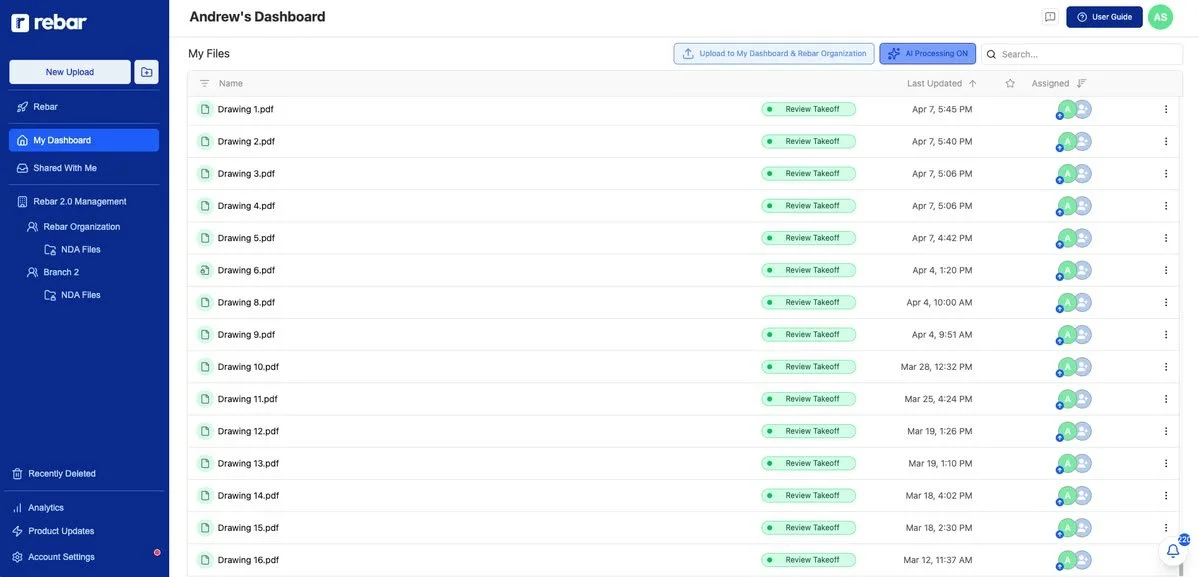
Image Source: Rebar
Rebar’s platform / interface
Rebar
Capturing human experience
Rebar's software reads construction drawings and specification books, pulling tens of thousands of data points from each project to produce a bill of materials and a quote. Brown told Crunchbase News that before Rebar, customers often spent up to a week preparing a proposal and won between 5 and 10 percent of the work they bid for. The platform produces proposals 60 to 70 percent faster, and early customer conversations suggest win rates may be improving too, though Brown notes construction contracts often take years to finalise, which makes the gains hard to measure. It’s trained on millions of blueprints, but Brown says the product works because it mirrors the workflows real estimators use.
Rebar doubled its annual recurring revenue during the first six weeks of 2026 using a usage-based subscription model. Seven of the company's forty customers have since become investors. They’ve spoken extensively about productivity gains and customer adoption, but not publicly about how future estimators will develop the practical judgement that informed the platform itself.
As AI automates more entry-level specialist work, organisations may need to rethink how expertise is developed, a challenge explored in our earlier analysis of AI-native learning, where learning systems are designed around human-AI collaboration rather than traditional apprenticeship models. As more specialist work becomes agentic, AI-native learning may become as important a strategic question as AI-native software.
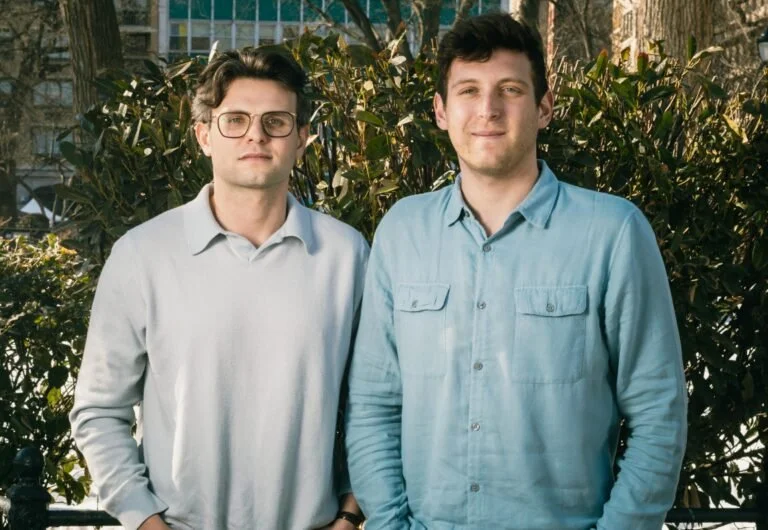
Image source: Crunchbase
Evan Brown and Andrew Schwartz, co-founders of Rebar (official founder photograph)
Amigo AI
Developing AI expertise
Ali Khokhar's mother was diagnosed with breast cancer when he was eight. Over six years and two diagnoses, he watched his family carry the coordination of her care, his mother retelling her history to each new specialist while referrals went missing between appointments. She died when he was fourteen. Writing about the raise, he remembered how much work it was just to be sick. In March 2026, Amigo AI raised an $11 million Series A round led by Madrona with participation from Optum Ventures, bringing its total funding to $17 million after a seed co-led by General Catalyst and GSV Ventures. The company, which Khokhar founded with John Xing, builds patient-facing clinical agents for intake, triage, care navigation, and round-the-clock support, against a backdrop the World Health Organisation has projected as a global shortfall of 10 million health workers by 2030.
While Rebar demonstrates how specialist workflows can be translated into software, Amigo goes a step further by making the learning process itself part of the product. Every clinical agent completes a "digital residency" before interacting with patients, borrowing one of medicine's oldest training models rather than relying solely on technical evaluation. The company reports its agents have completed more than three million patient encounters in six months with no reported safety incidents. "We train our agents like doctors because mistakes can cost lives in healthcare," Khokhar said in the announcement, which also confirmed the appointment of Dr. Jay Shah, chief of the medical staff at Stanford Health Care, as chief medical advisor. A patient does not experience healthcare as a series of clinical decisions. They experience it as the administrative connective tissue between those decisions, and that tissue is what Khokhar's agents are built to hold together.
The approach mirrors a broader shift across AI-native organisations, where learning is embedded into the system rather than left to experience alone. In Amigo's case, that principle is applied to the AI itself before it is trusted with patients. If AI-native learning reshapes how people acquire expertise, Amigo suggests it may also reshape how organisations develop AI itself.
Fazeshift
Challenges of generalisation
Caitlin Leksana and Timmy Galvin met as section-mates at Harvard Business School before founding Carma, a crypto startup that ultimately led them to a different problem. Running Carma, a crypto startup, they found themselves colour-coding spreadsheets by hand to track payments from just ten customers, the moment they later recounted to Crunchbase News as the origin of the pivot. A year and a half in, they skipped their own graduation festivities to launch Fazeshift and raise a first round, then went through Y Combinator's summer 2024 batch with Garry Tan, YC's president, as their group partner.
In May 2026, the company raised a $17 million Series A round led by F-Prime, with participation from Gradient, Y Combinator, Wayfinder, Pioneer Fund, and Ritual Capital, taking total funding to $22 million. Revenue grew twelvefold in a year. The customer list runs to dozens of enterprises including eight unicorns, among them Sigma Computing, Snyk, Meter, and Clipboard Health. For one client, the platform automated more than 9,000 customer communications in a single day. For another, it helped collect $7.4 million in cash within weeks of deployment.
Leksana calls accounts receivable a "snowflake" problem. A company can standardise its accounts payable on its own terms, but receivables bend to every customer's requirements, down to the large retailer that will only accept an invoice submitted through its own proprietary portal with specific attachments in specific formats. More than a million AR clerks in the United States spend their days moving between NetSuite, Salesforce, bank portals, and email threads because none of those systems talks to the others.
As reported by Fintech Global, Galvin, the CTO, holds computer science degrees from MIT, spent seven years as a nuclear submarine officer in the US Navy, taught cybersecurity at the Naval Academy, and holds a software patent for data algorithms. The product he has built executes rather than recommends. Fazeshift's agents generate the invoices, reconcile the payments, send the customer emails, and update the records directly across ERP systems, CRMs, and payment platforms, rather than surfacing tasks for a human to complete. It is long-sequence procedural work in which a missed step surfaces weeks later as missing cash, built by someone whose previous career consisted of running long procedures in which missed steps were not an option.
Whereas Rebar captures a specialist workflow, and Amigo introduces a structured learning model for AI, Fazeshift highlights a different challenge: expertise is rarely applied under identical conditions. Accounts receivable may follow the same objective, but almost every customer introduces a different process. The work lies in navigating thousands of small exceptions, where local rules, legacy systems and organisational quirks often matter more than the underlying task.
Prometheus
Cross-industry ambitions
There are two ways to acquire the domain expertise necessary to build vertical AI: you can buy it at scale, or you can bring it with you from the field.
The first three companies presented founders who brought years of practical experience with them, and that approach fits a narrow challenge. It becomes much harder when the ambition is to automate engineering itself.
Three months after the smaller vertical rounds, the largest AI round of the year went to Prometheus, the physical AI company co-led by Jeff Bezos and Vik Bajaj, raised $12 billion at a $41 billion valuation from Bezos, JPMorgan Chase, Goldman Sachs, and BlackRock to build what it calls an artificial general engineer, software intended to automate the design and manufacture of physical systems from jet engines to drug compounds. The company launched in November with $6.2 billion and employs roughly 150 people.
Bezos told CNBC that Prometheus may buy parts of companies that could benefit from its technology, and he has reportedly explored raising as much as $100 billion for an affiliated fund to acquire manufacturing businesses whose operations could feed the model. At the top of the market, the plan is to buy the domain, the factories, and the data inside them, and teach the software what the work looks like from the inside.
How Domain Expertise is Acquired
Top-Down (Prometheus)
Buys companies, factories, and data sets with billions of dollars in capital.
Bottom-Up (Vertical Startups)
Built by founder-experts who did the job manually for years before writing software.
Close
Knowledge as Infrastructure
These developments suggest that the most scarce resource in the AI economy is experience rather than raw computing power. Foundation models are becoming increasingly commoditised, unlike domain expertise, and the real value in AI is found in preserving decades of specialised human judgment and experience before it disappears with the people who carry it. There is no single fix. Protecting that expertise is a challenge for learning and organisational design as much as for the technology itself.