Tbc: The Agentic ‘Org Chart’
Reading Time: 8 Minutes

Image created by Superhumxn team.
McKinsey spent the last year figuring out what an agentic organisation should look like on paper. AI coding start-up Cognition is already ahead of the game IRL.
Scott Wu runs a fifteen-person engineering team at Cognition, the San Francisco company behind Devin, an autonomous AI software engineer. Each of those engineers works with about five instances of Devin at a time, assigning tasks through the same tools they'd use with a human collaborator. As of Wu's account on Lenny's Podcast in May 2025, those agents were producing about a quarter of Cognition's pull requests. The internal target was to reach half by the end of that year. By May 2026, Cognition announced its Series D at a $26 billion valuation, $492 million in annualised run-rate revenue, and a new figure: 89 percent of code committed at Cognition is now written by Devin, up from 13 percent in December 2025.
In September 2025, McKinsey published a five-pillar framework describing what it calls the "agentic organization."
This describes a company where AI agents act as full team members rather than tools layered onto existing workflows. The framework outlines three new roles:
M-shaped supervisors: Generalists fluent in AI who direct agents and hybrid teams.
T-shaped experts: Specialists who redesign workflows and manage errors.
AI-augmented frontline workers: Employees who spend less time on software systems and more time with people.
McKinsey estimates that two to five people can manage an agent factory of 50 to 100 specialized agents running an end-to-end process. This represents a 1-to-25 ratio at minimum, which goes far beyond what Cognition currently runs. Research has limits.
So how are early adopters approaching agentic teams?
What can I expect from a subscription?
Real-world strategies for navigating the future of work.
AI AGENTS AT WORK
Everything you need to know about how AI agents are changing teams and ways of working.
SUPERHUMXN IRL
Real insights from investors and operators.
MEMOS ON PEOPLE, CULTURE & AI AT WORK
The latest use cases and strategies for change and transformation.
Sticky tape
Human operating models
Most organisations deploying AI agents are doing it wrong, according to Prasun Shah, global CTO for workforce consulting and chief AI officer at PwC. Shah recently told MIT Technology Review it's like "adding sticky tapes to parts of an operating model that is breaking," embedding AI employees into an infrastructure built for humans rather than starting from first principles.
What's underneath, according to Deloitte's analysis, is an operating model that was never designed to hold autonomous agents, comparable to fitting a jet engine to a bicycle. Deloitte's State of AI in the Enterprise 2026 survey backs that up: 84 percent of companies haven't redesigned jobs to accommodate AI, even as most report high expectations for what automation will deliver. McKinsey's own research goes further, predicting that by 2030 three-quarters of current roles will need fundamental redesign, upskilling, or redeployment.
Digital transformation was about moving from paper to software. AI transformation seems focused on automating existing workflows, but that isn't enough. Ema and HFS Research have coined the term "agentic business transformation," or ABT, integrating AI agents into the fabric of the organisation rather than adding them on top of it. Surojit Chatterjee, Ema's founder and CEO, and Shah agree that a systemic overhaul is needed.
Ratio
Behind the numbers
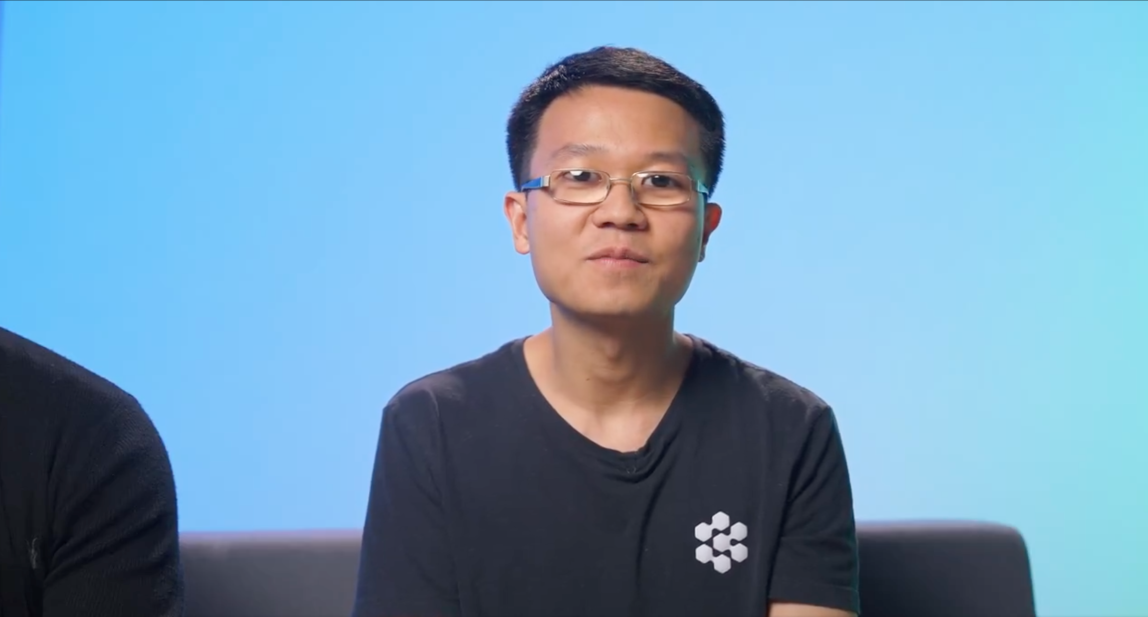
Image Source: TechCrunch
Scott Wu, CEO of Cognition, from TechCrunch Series D coverage, May 2026.
Each of Cognition's fifteen core engineers works alongside roughly five Devins at a time. They assign tasks through Slack, Linear, and GitHub the same way they'd coordinate with a human colleague.
The setup avoids chaos via strict technical boundaries. Devin sessions run inside isolated virtual machines with a dedicated shell, browser, and code editor, and the agent has no direct write access to live production environments. It proposes a pull request, and a human must manually review and merge it. This structural ‘choke point’ makes a 1-to-5 supervision ratio manageable. The engineer is not trusting five agents with unsupervised production access; they are reviewing five parallel streams of proposed work gated by explicit human approval.
This ratio also holds up elsewhere. In May 2026, TechTimes reported that the merge rate for Devin's pull requests across its broader customer base rose to 67%, up from 34% the year before. Inside Cognition, the impact is even higher, and Devin now writes 89% of all committed code. For comparison, when Mercedes-Benz needed to modernize a legacy system, the project took eight months; Devin completed a similar modernization in a staggering eight days.
McKinsey's own research on early adopters suggests a far higher ratio is achievable. Its agentic organisation framework estimates that two to five people can manage an agent factory of 50 to 100 specialised agents running an end-to-end process, a 1-to-25 ratio at minimum. Cognition is running at 1-to-5. The gap reflects the sandbox. A supervised pull request model caps both the risk and the ratio.
McKinsey also identified three new roles most companies will need to build for this transition. One of them, the M-shaped supervisor, is a generalist fluent in AI who manages agent output rather than doing the work directly. Cognition's engineers are an early version of that role, managing agents that still require human sign-off at every merge. As agents earn more trust and take on more autonomous action, the supervision ratio could potentially expand.
100x
Clickup's agentic organisation
On May 21st, ClickUp CEO Zeb Evans cut 290 people, 22 percent of the company's 1,300-person workforce, and announced the company was restructuring around roughly 3,000 internal AI agents at a 3-to-1 agent-to-employee ratio. He called it the "100x org."
Evans's reasoning was that "AI makes the best engineers wildly more productive," he wrote in a public post on X, "and everyone else using AI slows these engineers down." Essentially the judgment sits with experienced engineers, and layers of junior employees are no longer needed. Every role is eligible for salary bands reaching $1 million in cash annually, tied to demonstrated "100x impact" through building or managing AI systems.
ClickUp also maintains what Evans described as an "agent org chart," listing every internal agent by name, its owner, and its per-run cost. That gives the company visibility into what 3,000 agents are doing and who is accountable when something goes wrong.
The same week as ClickUp announced restructuring, Meta cut 8,000 roles and Oracle removed up to 30,000, part of a broader wave that has affected more than 100,000 tech workers across roughly 250 events in 2026. A Gartner survey of 350 executives at companies deploying autonomous AI found that 80 percent had cut jobs, but those reductions had not consistently produced better financial returns. "The people that automate their jobs with AI will always have a job," Evans wrote. The people who don't automate won't. In the US, no labour law prevents a company from replacing workers with AI agents, and across the world the legal regulatory environment is also still catching up.
Shape
The org chart is glitching
Traditional organisation charts depict a hierarchy of human relationships. One manager can only supervise so many juniors. But that constraint isn't just logistical. Managing humans involves psychological factors like managing conflict, emotional labour and individual motivations. Agents don't require any of that, so a senior engineer reviewing five Devins' pull requests isn't doing the same cognitive and interpersonal work as managing five direct reports. The span widens because the nature of what's being supervised has changed. Oxford Academic research published in January 2026 describes this as a shift "from execution to stewardship," humans moving from doing the work to overseeing systems that do it.
This isn't only happening in software. McKinsey's September 2025 research cites a global bank running ten agent squads on know-your-customer processes, with measurable improvements in output quality. A second bank used human supervisors overseeing agent teams to modernise legacy core systems, cutting time and effort by up to 50 percent.
The tricky part is measurement. Many companies that redeploy agents into existing workflows are still measuring performance the old way. Chatterjee explains: "when you add AI employees into the workforce, activity metrics become meaningless or actively misleading. An AI employee can handle a thousand customer interactions in the time it takes a human to handle ten. If you measure success by interactions handled, you'll conclude the AI is working brilliantly while missing whether any of those interactions actually drove value." Microsoft's 2026 Work Trend Index found that only 16 percent of AI users are actually redesigning how they work around agents. If the org chart is changing shape, workforce planning must change too.
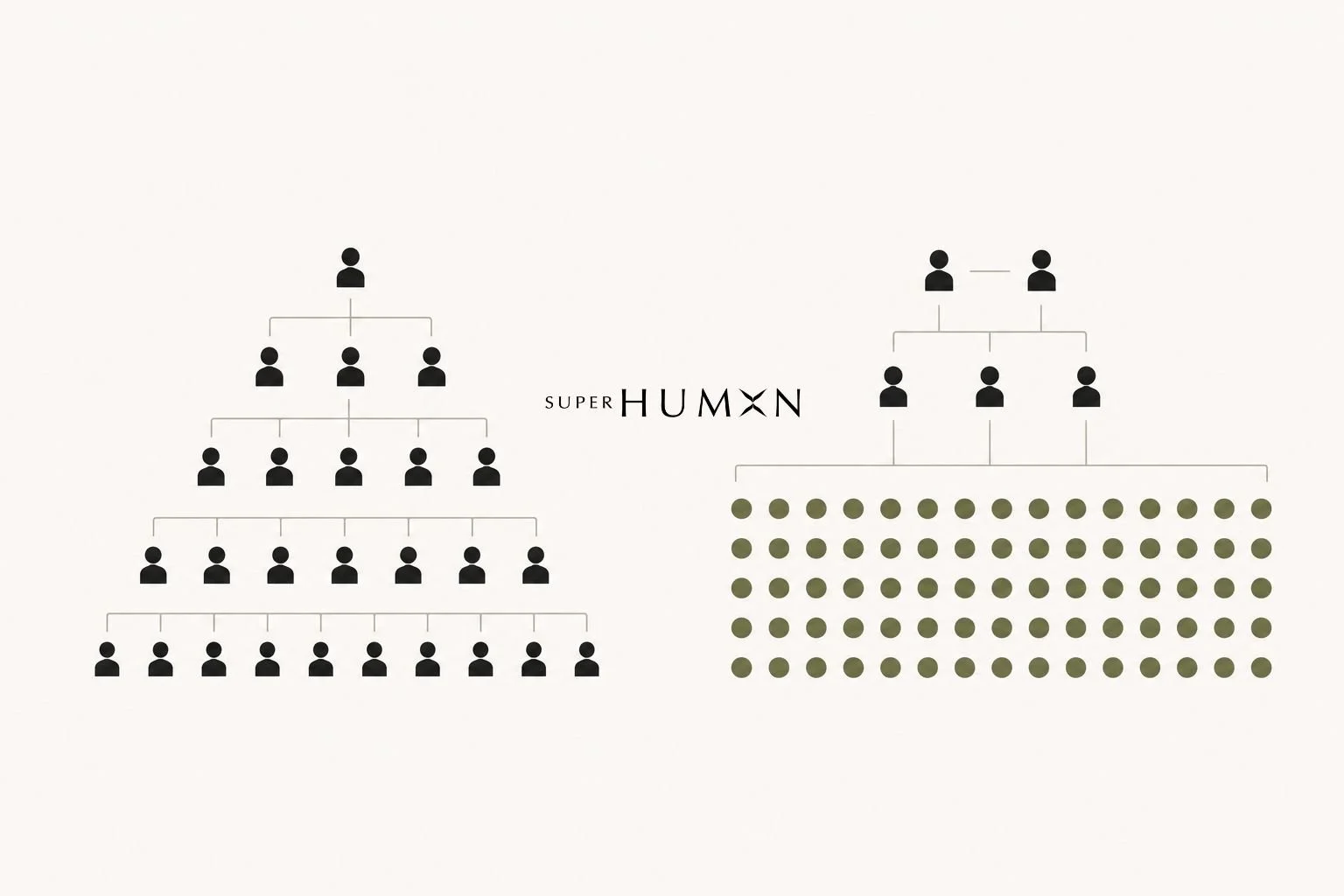
Image created by the Superhumxn team.
Practice
Are we guilty of ‘agent washing’?
Deloitte has coined the term "agent washing", suggesting vendors are rebranding existing automation as true agentic work design. The result is "workslop," which are applications that over-complicate processes because the underlying architecture was not addressed.
McKinsey's Quantum Black team documented what happens when designing agentic work from first principles. A large bank needed to modernise a legacy core system of 400 pieces of software, originally budgeted at more than $600 million. Rather than mapping agents onto the existing processes, the team redesigned the work around what agents could do. McKinsey's broader research on banks using human supervisors overseeing agent squads found time and effort reductions of up to 50 percent on comparable legacy modernisation work.
PwC's audit teams now use agents to handle specialised execution tasks, with human teams focusing on judgment and client relationships. PwC calls the emerging role the "new generalist", broader and more outcome-focused than the earlier specialist roles.
The new generalist role requires people who built IRL expertise pre-agents. Someone who has only ever directed agents, without having done the underlying work first, may not recognise when the agent is wrong. The long-term consequences could be generational. If companies build their workforces entirely around people who have only ever directed agents, they lose the institutional knowledge needed to catch what agents get wrong.
Close
A lingering question mark
Companies that succeed with agentic deployment usually invest heavily in technical guardrails before scaling. Deloitte's research shows that organisations struggling to capture value from AI often treat governance and risk management as an afterthought rather than a prerequisite
However, a deeper systemic risk remains: the erosion of human domain expertise.
An experienced software engineer can easily spot a flawed pull request from an agent because they spent years writing code manually. But a junior engineer whose primary career experience consists of reviewing AI-generated work lacks that foundational practice. They have fewer opportunities to develop the deep intuition required for high-level oversight. This training gap may appear years from now, when the engineers who learned by doing leave the workforce, leaving behind a layer of managers who lack the deep expertise required to audit the systems they supervise.