
Big Tech Is Getting Political
Reading Time: 7 Minutes
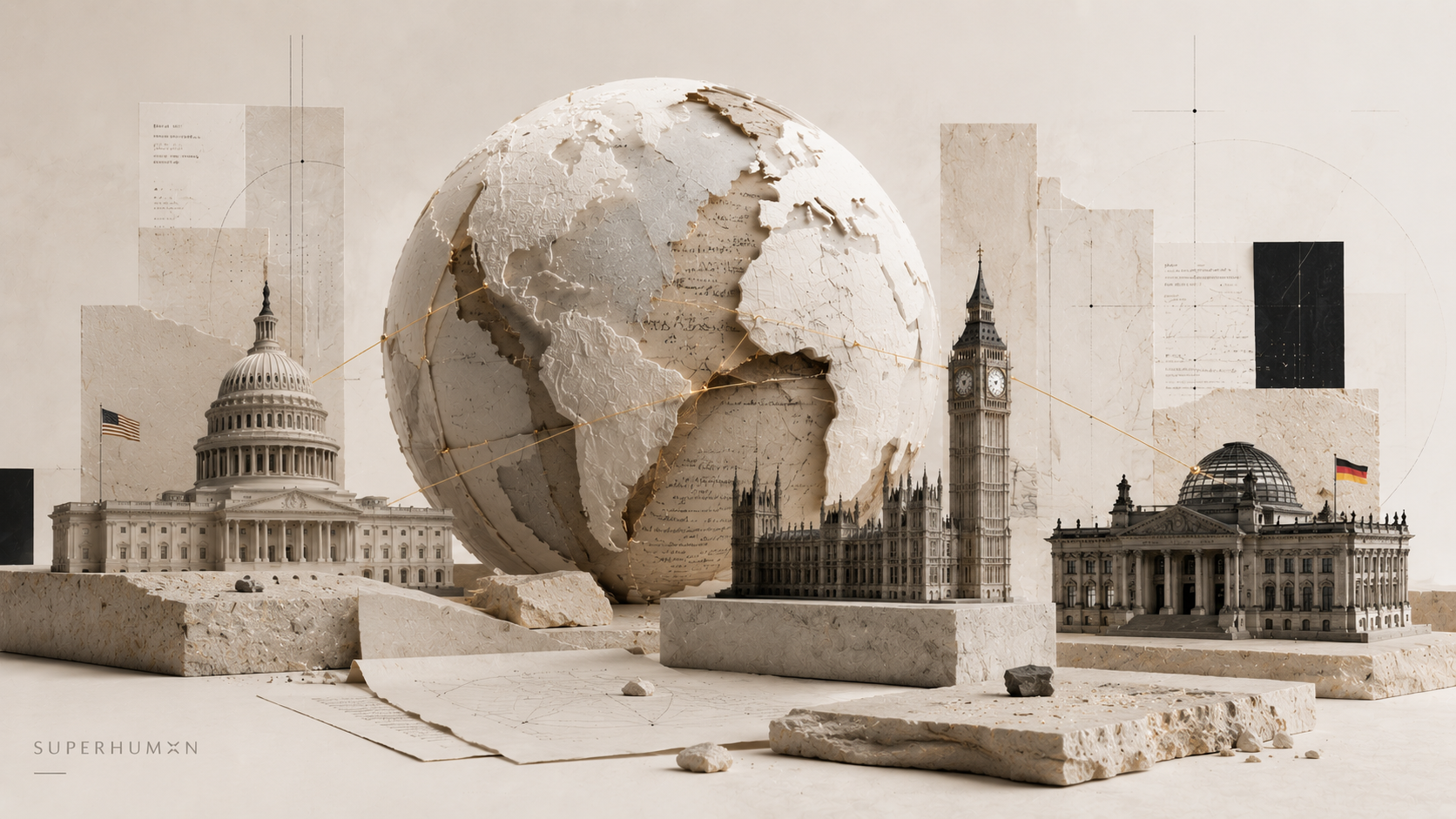
Image created by Superhumxn team.
Three governments backed three similar AI moves in the same eight weeks. Here's the story behind the headlines.
In February 2026, the US Department of War designated Anthropic a supply chain risk after the company refused to remove two contractual safeguards on how its AI could be used by the military. A few weeks later, the UK government launched a 500 million Sovereign AI Unit the same week OpenAI had paused its Stargate UK data centre project. Then in April, Cohere announced it was joining forces with Aleph Alpha in what both companies called a transatlantic AI powerhouse.
"Sovereign AI" covers data residency, model provenance, and jurisdictional control over how a system operates. The EU AI Act's transparency obligations land in August 2026, with high-risk system deadlines running through 2027 following a May 2026 political agreement. But in all three of these scenarios, the challenge each government addressed had little to do with foreign control of infrastructure.

What can I expect from a subscription?
Real-world strategies for navigating the future of work.
AI AGENTS AT WORK
Everything you need to know about how AI agents are changing teams and ways of working.
SUPERHUMXN IRL
Real insights from investors and operators.
MEMOS ON PEOPLE, CULTURE & AI AT WORK
The latest use cases and strategies for change and transformation.
US
Weapons and mass surveillance
In July 2025, Anthropic signed a contract making Claude the first frontier AI model approved for use on the Pentagon's classified networks, through a deal valued at up to $200 million. There were two restrictions included: Claude could not be used for fully autonomous weapons systems, and it could not be used for mass domestic surveillance of American citizens. The Pentagon agreed to those terms.
By early 2026, it wanted them removed. Defence Secretary Pete Hegseth gave Anthropic CEO Dario Amodei a deadline of 5:01 p.m. on February 27th to accept new terms granting the military use of Claude for "all lawful purposes" without restriction. Amodei refused. His position was that current AI models are not reliable enough for fully autonomous weapons, and that the two restrictions had not, to Anthropic's knowledge, blocked a single government mission.
Hegseth designated Anthropic a supply chain risk to national security the same afternoon. President Trump directed all federal agencies to stop using Anthropic products. Hegseth posted that no contractor, supplier, or partner doing business with the US military could have any commercial relationship with Anthropic. Trump later told Politico he had "fired them like dogs."
The legal vehicle for this was theFederal Acquisition Supply Chain Security Act of 2018, a law written to block contractors from using products tied to foreign adversaries. Huawei is the canonical application. Anthropic is headquartered in San Francisco. No foreign ownership, data exfiltration, or espionage was alleged. The statute was applied to a company that declined to remove two narrow product commitments from a vendor contract.
A senior Pentagon official told CNN that the department's position came down to one thing. The military cannot allow a vendor to insert itself into the chain of command by restricting the lawful use of a capability. That is a strong position to hold. It says nothing about foreign adversaries or infrastructure sovereignty.
Nearly 150 retired federal and state judges filed an amicus brief supporting Anthropic's legal challenge, arguing the Department of War had misinterpreted the statute and ignored the required procedures. Senator Elizabeth Warren wrote to Hegseth calling the move "retaliation" and writing that she was "particularly concerned that the DoD is trying to strong-arm American companies into providing the Department with the tools to spy on American citizens and deploy fully autonomous weapons without adequate safeguards." At a Senate hearing, Hegseth called Amodei an "ideological lunatic" and compared Anthropic's position to "Boeing giving us airplanes and telling us who we can shoot at."
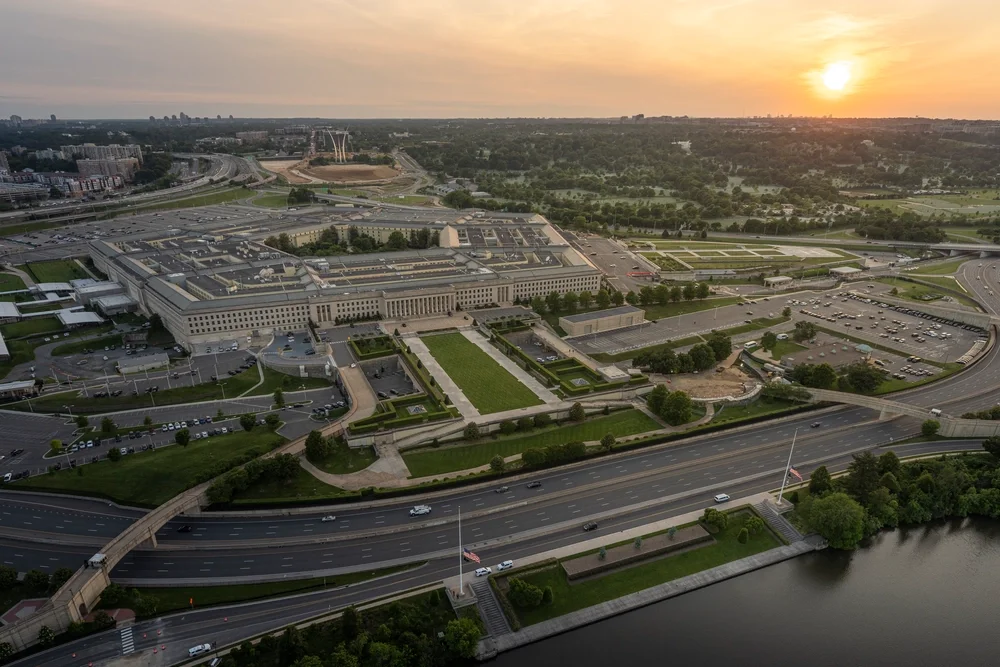
Image Source: US Department of Defense / DVIDS (public domain)
Aerial photograph of the Pentagon, Washington D.C., May 15, 2023.
Anthropic filed suit in two federal courts in March. By late May, the litigation had split. The Washington appeals court looked likely to uphold the designation while a California court had temporarily blocked enforcement against Claude specifically. Legal authority tends not to split across jurisdictions when the underlying question is clear. The authority comes under question only when the question itself is contested, as evident here.
But the Pentagon never stopped using Claude. A Pentagon official told a Senate subcommittee that Claude was being used in Operation Epic Fury, the US military's ongoing war against Iran, at the same time the supply chain risk designation was in effect. Pentagon CIO Kirsten Davies told Senator Jack Reed that senior leadership had been given 180 days to remove Anthropic's products, with exemptions possible for mission-critical activities where "no viable alternative exists." Palantir CEO Alex Karp confirmed publicly that Anthropic remained integrated into Palantir's tools and that the company would transition to other models in time. The supply chain risk designation, announced publicly as a sweeping national security measure, turned out to apply narrowly to Anthropic's contracting role while the military continued using the product it had just called a threat.
OpenAI struck its own deal with the Pentagon within hours of the Anthropic designation, a moment Sam Altman later admitted "looked opportunistic and sloppy." Microsoft, Google, and Amazon all confirmed Anthropic products would remain available through their platforms for non-Defence Department work. By May, DoD CTO Emil Michael told CNBC that Anthropic's new model Mythos was a "separate national security moment" because of its ability to find cyber vulnerabilities, even as the NSA was reported to be using Mythos despite the broader blacklist. The White House and Pentagon had visibly moved to different positions on Anthropic by May, with Trump telling CNBC a deal was "possible" and that the company's people have "high IQs," while Hegseth's department maintained the designation.
Claude topped the App Store in more than 20 countries in the week after the designation
UK
Strategy or not?
In September 2025, OpenAI announced Stargate UK, a data centre project at Cobalt Park in North Tyneside, built with Nvidia and Nscale, designed to deploy up to 8,000 GPUs in early 2026 and scale toward 31,000 over time. The UK government pointed to it as evidence that Britain was building the physical compute capacity to back its AI ambitions. Sam Altman called the UK "a longstanding pioneer of AI."
By April 2026, the project had stalled. OpenAI cited high energy costs and regulatory uncertainty around copyright and AI training rules, and said it would revisit the project when the right conditions were in place. Development had not moved past early construction stages.
Technology Secretary Liz Kendall stood at Wayve's London headquarters and announced the Sovereign AI Unit, a 500 million fund The fund would offer equity investments of up to 20 million per start-up, compute access through the national AI Research Resource network, and fast-tracked visas processed within one working day. The launch was presented as proactive and ambitious. A bet on British AI talent.
The numbers put it in context. The 500 million commitment amounts to roughly 0.6 percent of France's comparable infrastructure commitment and 0.079 percent of OpenAI's valuation at the time. At 20 million per company, the fund covers approximately 25 equity investments.
France built its position differently. Mistral's sovereign cloud platform near Paris holds over 18,000 Nvidia systems, financed in part by roughly €10 billion from Bpifrance committed through 2029. That commitment predates any equivalent crisis. France built domestic compute capacity ahead of needing it. OpenAI pulled out over energy costs. A week later the UK announced a fund. But the launch was presented as a proactive strategy although the government had just realised its entire AI infrastructure plan depended on OpenAI staying. Perhaps the UK never really had a strategy here.
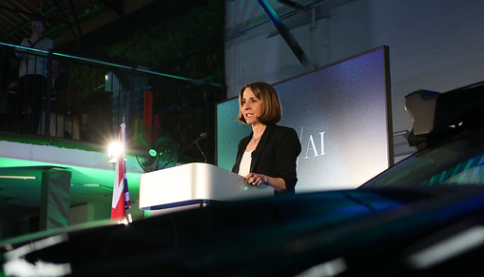
Image Source: Department for Science, Innovation and Technology, UK Government
Secretary of State Liz Kendall speaking at the Sovereign AI Unit launch at Wayve's headquarters, London, 16 April 2026.
Germany
Merger or acquisition?
On April 24th, Cohere and Aleph Alpha announced a combination valuing the combined entity at $20 billion. The announcement took place in Berlin. Germany's Digital Minister Karsten Wildberger and Canada's AI Minister Evan Solomon both attended. Both called it a transatlantic AI powerhouse. We covered the Cohere-Aleph Alpha deal in depth in a previous piece.
According to reporting from Handelsblatt, Cohere shareholders will receive approximately 90 percent of the combined company. Aleph Alpha shareholders will receive approximately 10 percent. Schwarz Group committed $600 million to Cohere's Series E as part of the arrangement.
Aleph Alpha's 10 percent stake needs context. Founded in Heidelberg in 2019 by Jonas Andrulis and Samuel Weinbach, Aleph Alpha raised €500 million in a Series B in November 2023 at a €5 billion valuation, backed by Bosch, SAP, and Schwarz Group. It was positioned as Germany's answer to OpenAI. By mid-2024, it had pivoted away from building frontier models entirely, unable to compete at the scale US labs were operating at, and repositioned as an enterprise AI platform. By October 2025, Andrulis stepped down, moving to chairman of the advisory board. Two executives with ties to Schwarz Group's retail operations took over as co-CEOs. A 17 percent workforce reduction followed in January 2026, three months before the Cohere deal was announced. According to Handelsblatt, Aleph Alpha's standalone valuation at the time of the deal was around €500 million, a fraction of what it had raised at in 2023.
Cohere was in a stronger position but had its own challenges. The Toronto-based company reported $240 million in annual recurring revenue as of 2025, and had been seeking to expand into European government markets where data residency and independence from US providers are increasingly key procurement criteria. The $20 billion combined valuation represents a significant leap from both companies' standalone positions, one that the combined revenue alone does not justify, and reflects the political backing on both sides as much as the commercial reasoning.
A 90/10 ownership split on a deal where one party had just reduced its workforce, replaced its founder, and was valued at a fraction of its 2023 peak is a straightforward acquisition. But this is not how the deal was described.
The Canada-Germany Sovereign Technology Alliance, a bilateral agreement on technology sovereignty signed earlier in 2026 before this transaction was negotiated, gave both governments a ready-made context for the announcement. Ottawa's earlier $240 million CAD investment in Cohere had already demonstrated to German counterparts that Canadian government backing was strong. The bilateral framework was in place, and the acquisition fit neatly.
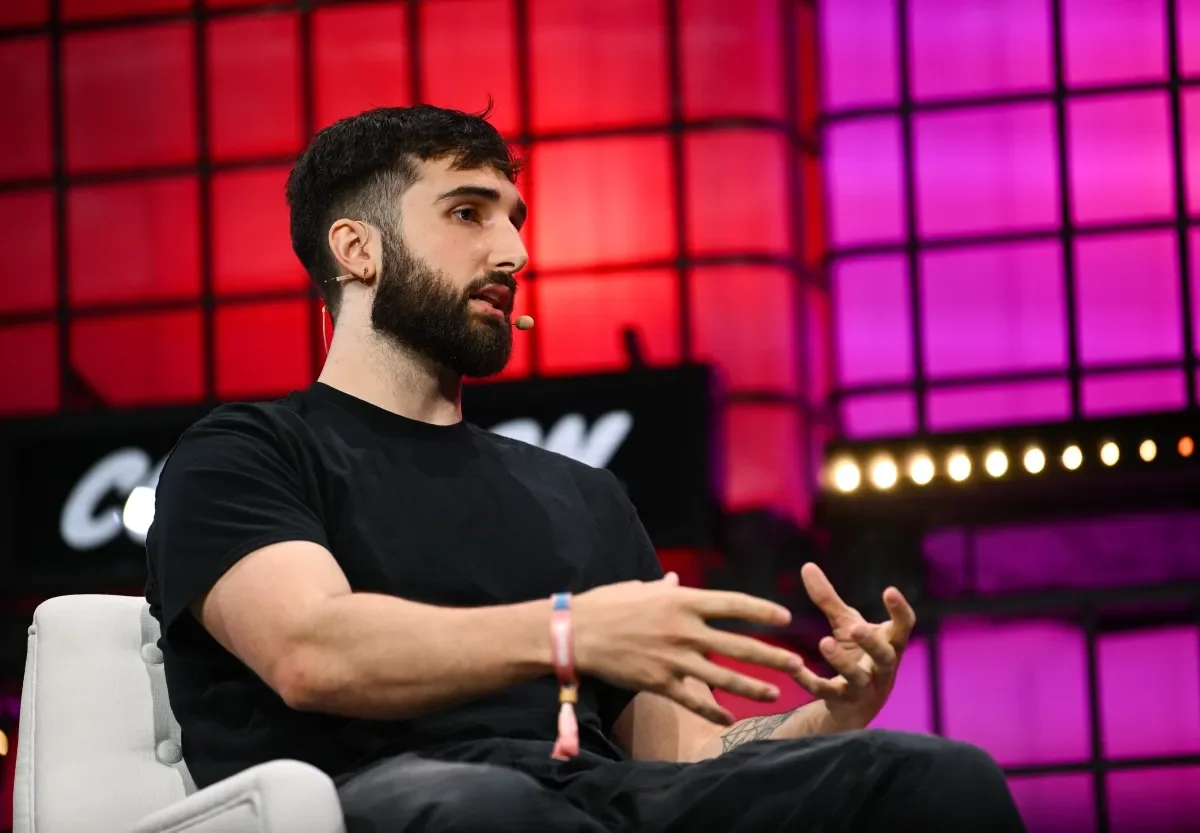
Image Source: Ramsey Cardy/Sportsfile For Collision/Getty
Cohere CEO Aidan Gomez.
Collapse
The Pentagon tried to use a foreign adversary statute to compel a domestic company to drop two safety commitments, then continued using that company's products through an active war while arguing in court that those products were a national security threat. The UK announced a sovereign AI fund the week OpenAI paused its data centre investment and walked away. Canada and Germany announced a partnership that was, by ownership, a 90 percent Canadian acquisition of a company that had just cut 17 percent of its staff and seen its founder depart.
In each case there’s a narrative gap between what was shared and what took place. With many more political AI announcements inevitable in 2026, evaluating cross-border AI deals will likely increase in complexity.
